Friday, 11 March 2011
CONSTRUCTIVIST MATH Correcting Method
REFERENCE:
Bedley, Tim. (October 11, 2008). Constructivist Math Correcting Method (YouTube). Retrieved March 11, 2011 from http://www.youtube.com/watch?v=Xe1Ei4wYR3E.

Cognitivism
The Modal Model Of Memory

Dr. Graham Cooper
University of New South Wales, Australia
(December 1998)
University of New South Wales, Australia
(December 1998)
Cognitivism is the mental processes of knowledge and understanding in 3 stages (shown in the diagram above). Cognitive development is the stages in life at which it is learned.
Schemas
- Higher Order Concepts
- Lower Order Concepts
- Experts have expansive schemas as opposed to novices with limited schemas.
- Experts have high level of automation.
- Experts not necessarily more intelligent or thoughtful.
"What we see and remember depends more on what we already know, than on what is actually presented."
REFERENCE:
Cooper, Graham Dr. (December 1998). Research into Cognitive Load Theory and Instructional Design at UNSW. Retrieved March 13, 2011, from http://dwb4.unl.edu/Diss/Cooper/UNSW.htm.
REFLECTION
I was interested to discover the processes of Human Cognitive Architecture. In particular the way our working memory functions in conjunction with our long term memory, whilst understanding the limitations of the two.
Learning in depth about what defines a novice and an expert in this particular genre, it becomes evident to me that most of us without realising, are more of an expert than a novice. Considering of course that majority can walk, talk, read, write, drive etc with high level automation. Just the few I have mentioned here are classed as being the "most difficult we will ever master". Thus making us an expert in these schemas.
Cognitive Development is life long and I believe cannot be measured when you consider it's memory related. Depending on the situation, surroundings, senses etc, depends on the activation of the individuals memory in that moment in time.

21st Century Learners
I find Prensky somewhat of a dimwit! His readings basically inform us that the pedagogies associated with Digital Immigrants, are useless in todays society due to technology. Last time I checked my car still had a steering wheel and pedals to drive it. While technology has come a long way and will continue to be a strong influence on our Digital Natives, society is not entirely driven by the technology Prensky is referring to.
Digital Natives while learning a new language to that of their predecessors, still require in my opinion, the pedagogies learnt by generations before them. The idea of computer games being the learning style of the future is absolutely absurd. Firstly not every student is a visual or kinesthetic learner and video games are basically appealing to these two styles. Not to mention they fail to achieve anything other than brainwashing Digital Natives. Lets face it, how many adolescents do you know use most of their time on the computer or even mobile phone for that matter, for educational purposes. Yet in schools today we have computers for use as an educational tool and have had for about two decades now.
Prensky is suggesting that adopting "edutainment" within the education system would "engage" rather than "enrage". So to entertain this idea would be to allow the Digital Natives to control their behavioural management. Already teachers and parents have almost no rights in todays society. Now Prensky wants to hand even more control over to them, in the form of their curriculum for fear of "enrage". How about conform to the same pedagogies that were good enough for the many generations before you! Yes our teaching techniques need to meet the developments of the 21st century, but that doesn't mean the content has to change. These Digital Natives should be made learn to add and subtract without calculators, spell words that are used in everyday language and learn to read the directions on a map. Let's face it when they finish school and go out into the workforce is their employer going to say, "No Johnny, you don't have to read the manual for this machine you can play Monster Trucks instead. That will teach you everything you need to know about the machine." I think not. They will have to read and learn in the same fashion the Digital Immigrants have before them.
While I find some of the elements of Prensky's findings to be benefitial to the future pedagogies for Digital Natives, his overall summary of the 21st century and its education system favour one side. Digital Natives are still learning and Digital Immigrants are their teachers. So it would make sense that while Digital Immigrants need to consider the development of technology in the 21st century and its impact on the education system; they also need to control the behavioural management "enrage", while collaboratively networking the relevant teaching strategies, most effective for the Digital Natives learning development.
REFERENCE:
Prensky, Marc. (October 2001). 'Digital Natives, Digital Immigrants', in MCB University press, Vol. 9 No. 5. Retrieved March 11, 2011, from http://www.marcprensky.com/writing/Prensky%20-%20Digital%20Natives,%20Digital%20Immigrants%20-%20Part1.pdf.
Prensky, Marc. (September/October 2005). 'Engage me or Enrage me: What today's learners demand', in Educause review, p60-64. Retrieved March 11, 2011, from http://net.educause.edu/ir/library/pdf/erm0553.pdf.
Digital Natives while learning a new language to that of their predecessors, still require in my opinion, the pedagogies learnt by generations before them. The idea of computer games being the learning style of the future is absolutely absurd. Firstly not every student is a visual or kinesthetic learner and video games are basically appealing to these two styles. Not to mention they fail to achieve anything other than brainwashing Digital Natives. Lets face it, how many adolescents do you know use most of their time on the computer or even mobile phone for that matter, for educational purposes. Yet in schools today we have computers for use as an educational tool and have had for about two decades now.
Prensky is suggesting that adopting "edutainment" within the education system would "engage" rather than "enrage". So to entertain this idea would be to allow the Digital Natives to control their behavioural management. Already teachers and parents have almost no rights in todays society. Now Prensky wants to hand even more control over to them, in the form of their curriculum for fear of "enrage". How about conform to the same pedagogies that were good enough for the many generations before you! Yes our teaching techniques need to meet the developments of the 21st century, but that doesn't mean the content has to change. These Digital Natives should be made learn to add and subtract without calculators, spell words that are used in everyday language and learn to read the directions on a map. Let's face it when they finish school and go out into the workforce is their employer going to say, "No Johnny, you don't have to read the manual for this machine you can play Monster Trucks instead. That will teach you everything you need to know about the machine." I think not. They will have to read and learn in the same fashion the Digital Immigrants have before them.
While I find some of the elements of Prensky's findings to be benefitial to the future pedagogies for Digital Natives, his overall summary of the 21st century and its education system favour one side. Digital Natives are still learning and Digital Immigrants are their teachers. So it would make sense that while Digital Immigrants need to consider the development of technology in the 21st century and its impact on the education system; they also need to control the behavioural management "enrage", while collaboratively networking the relevant teaching strategies, most effective for the Digital Natives learning development.
REFERENCE:
Prensky, Marc. (October 2001). 'Digital Natives, Digital Immigrants', in MCB University press, Vol. 9 No. 5. Retrieved March 11, 2011, from http://www.marcprensky.com/writing/Prensky%20-%20Digital%20Natives,%20Digital%20Immigrants%20-%20Part1.pdf.
Prensky, Marc. (September/October 2005). 'Engage me or Enrage me: What today's learners demand', in Educause review, p60-64. Retrieved March 11, 2011, from http://net.educause.edu/ir/library/pdf/erm0553.pdf.
Reflection on Multiple Intelligences
No surprises here that I'm a kinesthetic learner. I've always been the type to get distracted easily and struggle to focus for long periods of time or in some cases even short periods of time. What can I say? I like to get in there and just do it! Reading and listening to me are mundane activities, unless of course i'm listening to music or something that I thoroughly enjoy. With this in mind, I guess I need to find ways to integrate kinesthetic learning into my courses, so that I don't get too distracted and fall behind.
Multiple Intelligence Questionnaire Results
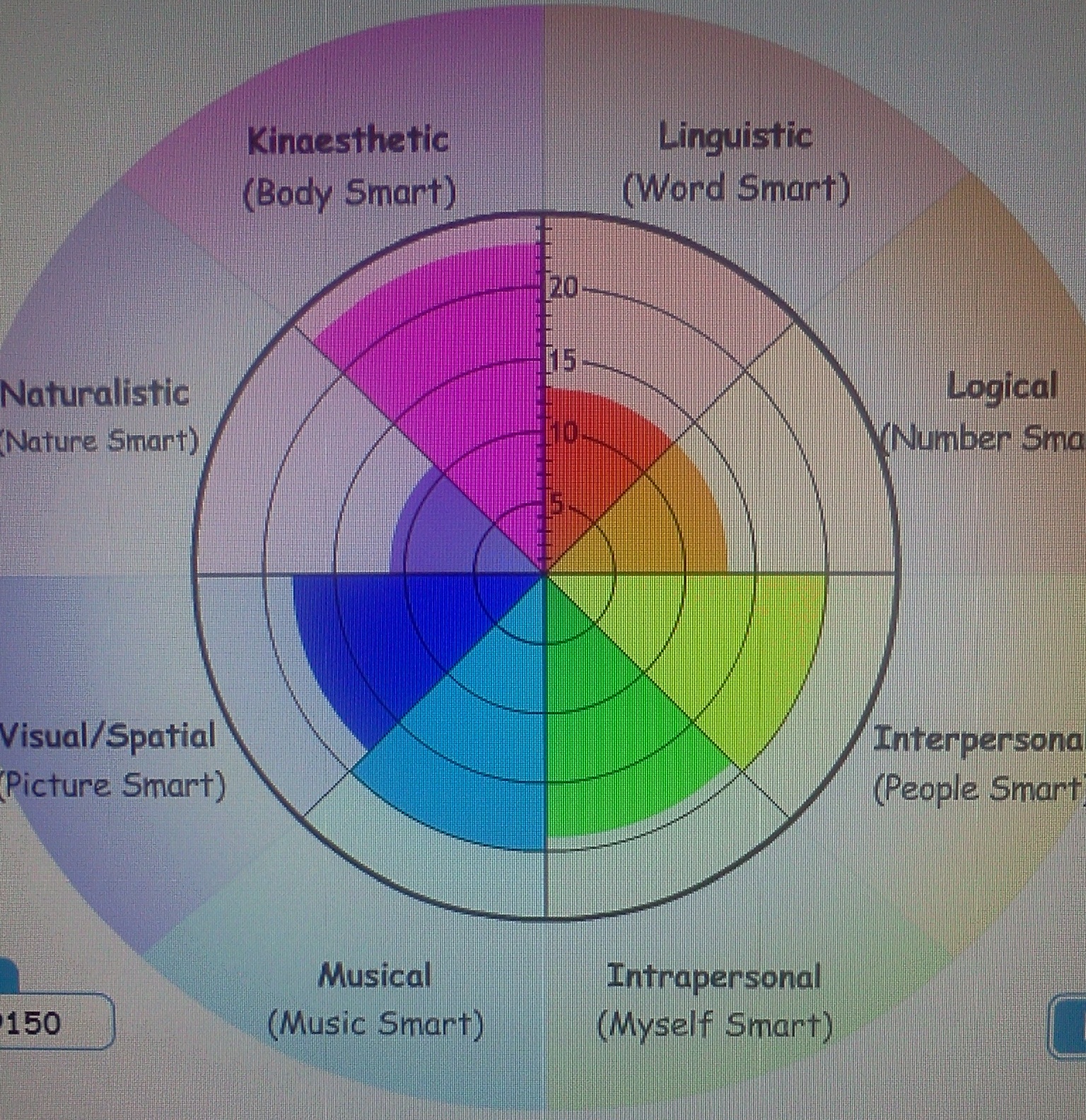
Results from the Multiple Intelligence Questionnaire based on Gardner's 8 categories for different intelligences.
REFERENCE:
Birmingham Grid for Learning (BGL) 2011. Multiple intelligences. Retrieved March 11, 2011, from http://www.bgfl.org/bgfl/custom/resources_ftp/client_ftp/ks3/ict/multiple_int/what.cfm
Friday, 4 March 2011
Reflection on Felder & Solomon's Questionnaire
1. What is your learning style? What sorts of learning experiences would suit you best with your learning style?
My profile results indicate I'm more of an active rather than a reflective learner. Thus demonstrating the verbal form of learning, testing a process out physically and working more in groups to be more beneficial.
According to Felder & Solomon "Everybody is active sometimes and reflective sometimes." My results indicate I'm mild to moderately active. I would have to agree with these findings. I've never been the type of learner to think things through first and reflection in itself just doesn't interest me. Though there are parts of the active learner that don't quite fit me either. Problem solving has over the years, been a strength of mine and I can't say I've ever lacked "discussion" in class.
I certainly sit into sensing over intuitive. My results here indicate I'm a moderately sensing learner. I found this quite an interesting read. Sensing is so me. I am a very cautious learner. I certainly like my facts and again a sensing learner is more practical which is in alignment with the previous result of active learner. So it seems apparent that if your an active learner, your not necessarily but probably more likely, going to be a sensing learner also. My innovative thinking has always needed improvement and with my results being moderate as a sensing learner, indicates why that is. What can I say? Sometimes its just hard work getting the motor to run...
VISUAL! VISUAL! VISUAL! I scored a 9 here. Seriously! I hear and I forget, I see and I remember, I do and I understand. That's the simplest way for me to explain it.
I am most certainly a sequential learner. While I do have those light bulb moments as I believe we all do at some point in our lives, I can understand and follow the material most of the time. While I like to follow the steps when learning new material, depending on the circumstances I can at times deal with skipping certain details.
Recapping the findings here based on Felder and Solomon's questionnaire; I'm an active, sensing, visual and sequential learner. In terms of learning experiences, I would certainly benefit from an interactive group orientated learning environment, that has a sequential theme involving facts and relevant assessable topics. However I need to learn not only to adapt to the needs of other students but also to improve on my weaknesses. Personally I think its important to use all forms of learning experiences, particularly ensuring that as a teacher, you are including the experiences that best relate to the students you are teaching. That way you are ensuring that they are learning through their chosen methods, but also learning to adapt and strengthen their others.
2. In a traditional classroom of 25 students, how would you support the range of learning styles each lesson?
Conducting a basic questionnaire with the students to establish which learning style they are would be a starting point. From there I would have an idea of what the majority of my learners needs are. When planning a lesson I would consider the technique best suited, however I would engage them in all styles of learning at some point during each day to improve on their weaknesses. I think its important to be multi-skilled both as a learner and a teacher for the purpose of being able to adapt to all situations.
3. With your current knowledge of ICT, how could your design and digital pedagogy support your learners better?
5. How does ICT support differences in learning styles?
ICT allows for a much more creative approach to teaching. There are so many various techniques in terms of this. Engaging them and continually being creative in your approach I think is important. Using various different ICT tools for digital pedagogy not only assists with students interests but also teaches them different learning styles and techniques. Not to mention the endless resources now made readily available at the click of a button. However in my opinion there aren't all positives in relation to this new innovative design to pedagogy. The Digital Natives due to ICT support today has become what I believe to be the "lazy" generation. So much is done for them. While ICT is the way of the future it is also crippling the Digital Natives by taking away their need to spellcheck, punctuate, apply grammar, complete calculations and achieve even basic art by drawing a picture of the oval for a class activity. These days they have mobile phones to take pictures instead of drawing and these phones have also provided a calculator to prevent them from having to calculate even the simplest maths. Meanwhile computers are constantly correcting their grammar for them. Not to mention most forms of writing these days from Digital Natives is via texting/emailing/blogging which in most forms is shorthand thus preventing some of these students from even learning to spell at all. So while ICT has its benefits and I certainly believe it does and is essential in the learning and development of the Digital Natives, I can't help but feel that this generation is becoming lazier and therefore less educated then the Digital Immigrants before them.
REFERENCE:
Felder, R.M., & Solomon, B. 2011. Learning styles test. Retrieved March 4, 2011, from http://www.engr.ncsu.edu/learningstyles/ilsweb.html.
My profile results indicate I'm more of an active rather than a reflective learner. Thus demonstrating the verbal form of learning, testing a process out physically and working more in groups to be more beneficial.
According to Felder & Solomon "Everybody is active sometimes and reflective sometimes." My results indicate I'm mild to moderately active. I would have to agree with these findings. I've never been the type of learner to think things through first and reflection in itself just doesn't interest me. Though there are parts of the active learner that don't quite fit me either. Problem solving has over the years, been a strength of mine and I can't say I've ever lacked "discussion" in class.
I certainly sit into sensing over intuitive. My results here indicate I'm a moderately sensing learner. I found this quite an interesting read. Sensing is so me. I am a very cautious learner. I certainly like my facts and again a sensing learner is more practical which is in alignment with the previous result of active learner. So it seems apparent that if your an active learner, your not necessarily but probably more likely, going to be a sensing learner also. My innovative thinking has always needed improvement and with my results being moderate as a sensing learner, indicates why that is. What can I say? Sometimes its just hard work getting the motor to run...
VISUAL! VISUAL! VISUAL! I scored a 9 here. Seriously! I hear and I forget, I see and I remember, I do and I understand. That's the simplest way for me to explain it.
I am most certainly a sequential learner. While I do have those light bulb moments as I believe we all do at some point in our lives, I can understand and follow the material most of the time. While I like to follow the steps when learning new material, depending on the circumstances I can at times deal with skipping certain details.
Recapping the findings here based on Felder and Solomon's questionnaire; I'm an active, sensing, visual and sequential learner. In terms of learning experiences, I would certainly benefit from an interactive group orientated learning environment, that has a sequential theme involving facts and relevant assessable topics. However I need to learn not only to adapt to the needs of other students but also to improve on my weaknesses. Personally I think its important to use all forms of learning experiences, particularly ensuring that as a teacher, you are including the experiences that best relate to the students you are teaching. That way you are ensuring that they are learning through their chosen methods, but also learning to adapt and strengthen their others.
2. In a traditional classroom of 25 students, how would you support the range of learning styles each lesson?
Conducting a basic questionnaire with the students to establish which learning style they are would be a starting point. From there I would have an idea of what the majority of my learners needs are. When planning a lesson I would consider the technique best suited, however I would engage them in all styles of learning at some point during each day to improve on their weaknesses. I think its important to be multi-skilled both as a learner and a teacher for the purpose of being able to adapt to all situations.
3. With your current knowledge of ICT, how could your design and digital pedagogy support your learners better?
- Do you prefer to work on a task in a group or alone?
- Would you rather read a book, listen to music or play sport?
- Do you have better understanding taking notes from a class, seeing the explanation displayed in diagrams/tables etc or taking part in an activity involving the process of the task?
- When you perform a task do you prefer to master one way of doing it or come up with new innovative ways of doing it?
- When writing a paper do you prefer to write from the beginning and progress forward or work on different parts of the paper and then order them?
5. How does ICT support differences in learning styles?
ICT allows for a much more creative approach to teaching. There are so many various techniques in terms of this. Engaging them and continually being creative in your approach I think is important. Using various different ICT tools for digital pedagogy not only assists with students interests but also teaches them different learning styles and techniques. Not to mention the endless resources now made readily available at the click of a button. However in my opinion there aren't all positives in relation to this new innovative design to pedagogy. The Digital Natives due to ICT support today has become what I believe to be the "lazy" generation. So much is done for them. While ICT is the way of the future it is also crippling the Digital Natives by taking away their need to spellcheck, punctuate, apply grammar, complete calculations and achieve even basic art by drawing a picture of the oval for a class activity. These days they have mobile phones to take pictures instead of drawing and these phones have also provided a calculator to prevent them from having to calculate even the simplest maths. Meanwhile computers are constantly correcting their grammar for them. Not to mention most forms of writing these days from Digital Natives is via texting/emailing/blogging which in most forms is shorthand thus preventing some of these students from even learning to spell at all. So while ICT has its benefits and I certainly believe it does and is essential in the learning and development of the Digital Natives, I can't help but feel that this generation is becoming lazier and therefore less educated then the Digital Immigrants before them.
REFERENCE:
Felder, R.M., & Solomon, B. 2011. Learning styles test. Retrieved March 4, 2011, from http://www.engr.ncsu.edu/learningstyles/ilsweb.html.
Subscribe to:
Posts (Atom)